
Growth

The gym member win-back strategy most owners overlook isn't a new ad campaign, it's a list that's already sitting in their CRM gathering dust. This guide breaks down the exact Gym Launch Reactivation Play: a 3-day SMS and email campaign that turns cold, inactive contacts into booked consultations and paid members. No ad spend required. Just a proven sequence, two smart offers, and the discipline to work the list you already have.
Here's an uncomfortable truth for most gym owners: you're probably only closing 10–20% of the leads you generate. That means 80–90% of every prospect who has ever raised their hand, clicked your ad, or walked through your door is sitting in a spreadsheet somewhere — completely untouched.
Add your list of inactive and cancelled members on top of that. These are people who already know you, already trusted you enough to try you once, and left not because they hate you, but because the timing wasn't right. Life got in the way. The budget got tight. The habit didn't stick. But that was back then.
That combined list (old leads plus inactive members) is your most underutilized asset. And it doesn't cost a dollar in ad spend to activate it.
At Gym Launch, we developed a specific campaign to do exactly this. We call it the Reactivation Play.
It's a 3-day, two-offer drip sequence deployed via SMS and email that consistently generates reply rates of 5–20% and closes 0.5–1% of total lists into paid memberships.
The median cash collected across gyms that ran this play for the first time? $5,711 in 3 weeks. And when you consider that retaining or reactivating an existing customer costs five times less than acquiring a new one, it becomes obvious why this is the highest-ROI move most gym owners aren't making.
The majority of inactive members and unconverted leads didn't leave because they hate your gym. They left because the timing wasn't right — budget shifted, a habit broke, life got in the way.
The same applies to the 80–90% of leads who never converted; most didn't say no, they said "not right now." According to research on exercise habit formation, disrupted routines — not lack of motivation — are the primary reason people disengage from fitness programs. That means the people on your win-back list are far more ready to return than most gym owners assume.
This is why the gym member reactivation opportunity is so strong, and why this member win-back play is built around a personal touch rather than an aggressive sales push.
The people on your list are warm in a way cold traffic will never be. They just need the right nudge at the right moment:
Sort your list by two factors: recency and list warmth. Because more recent contacts convert at higher rates, and contacts who've received consistent value respond better than those who've been ignored or spammed. Sort your list by these two factors before you send a single message, and work highest-probability contacts first:

The goal of segmenting isn't to skip people — it's to sequence them. Work your highest-probability contacts first so that when you're still building momentum and refining your follow-up process, you're doing it with the people most likely to convert. As Gym Launch emphasizes: every positive reply is worth thousands of dollars. Protect your capacity to respond to every single one of them.
This is the engine of the gym member reactivation campaign. Six SMS messages and two emails, timed precisely over three days. SMS in particular is a powerhouse channel: SMS messages carry an open rate above 90%, with most read within 3 minutes of receipt — making it the right primary channel for a time-sensitive campaign like this.
Follow the steps below to grab the exact SMS and Email Sequence our Gym Owners use, totally FREE:
The Reactivation Play is built around two distinct offers deployed in sequence. Each one serves a different psychological purpose. Here's how we define them:
The Transformation Pass is a free consultation — but it's not framed as a consultation. It's positioned as an exclusive, limited-quantity pass that comes with tangible value: a body composition scan, a one-on-one goal-setting session, and optionally a small gift (like a $10 Starbucks gift card). The key distinction: this is not a free transformation. It's a pass to do a consultation with bells and whistles, dressed up to feel like a prize worth claiming.
Why it works: The offer removes the intimidation factor of "joining a gym" while creating urgency through scarcity ("only 10 passes available"). It opens the door to a face-to-face conversation where you can close them on your program.
The Clean-Up Offer is a free class or free fitness session, deployed on Day 3 of the campaign. At this point in the sequence, you've told your list that the Transformation Pass appointments are full — and you're creating a new, more accessible entry point for people who didn't respond in time (or didn't feel ready for a consult).
A free class is a lower-commitment ask than a one-on-one consultation, which means it catches a different segment of your list — the people who are interested but aren't quite ready to sit down and have their goals interrogated. Getting them through the door for even one session is your opportunity to convert them through the experience itself.
Getting someone to come back is only half the job. If you reactivate a member and they have the same experience that led to their original cancellation — they'll cancel again, faster. The win-back fitness client who churns twice is twice as hard to win back a third time.
Here's how Gym Launch coaches gym owners to lock in reactivated members so they stick around long-term, tied directly to the 5 Horsemen of Retention framework:
From their very first week back, reactivated members need to be on your MIA radar. If they don't show up Monday through Wednesday, someone from your team calls or texts Thursday morning — no exceptions. You're showing them that this time is different. You notice. You care. People stay at gyms where they know someone will miss them if they disappear.
Reactivated members aren't just new members — they're people who left once before. That means the relationship-building work has to be more intentional, not less. Text them once a week. Not always about workouts. Ask how things are going. Reference something personal you know about them. This is white-glove, high-touch retention work, and it's what separates a gym that keeps members for two months from one that keeps them for two years.
The moment someone comes back, send them a handwritten welcome-back card. Reference something specific — a goal they mentioned, a milestone they hit before, how glad you are to see them back. This takes four minutes and costs less than a dollar. It is also one of the most powerful retention tools Gym Launch has identified across hundreds of gym clients. Nobody else is doing it. That's exactly why it works.
The single biggest predictor of long-term member retention is whether or not a member feels genuinely connected to the community — not just the workouts. Within the first 30 days of a reactivated member's return, personally invite them to an internal social event, challenge, or member gathering. When they start building friendships inside your gym, leaving becomes significantly harder. The gym becomes a second home, not a line item on a budget.
For the full long-term retention framework that runs alongside this win-back system, check out our 90-Day Client Journey — it covers the protocol in more detail.
Here’s a snapshot of a few of our clients' results the very FIRST time we tested this. Each of these gyms offer different types of memberships at different prices, different teams, different list sizes, some lists were warmer than others, and all were in different markets.
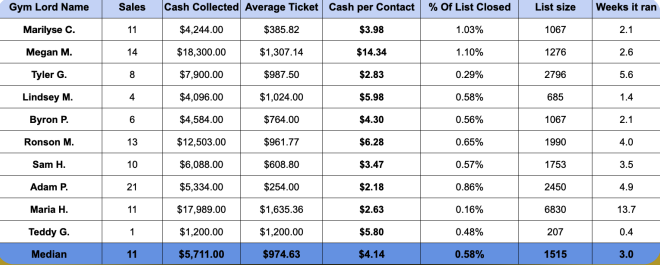
We have seen the play work on lists spanning several years, though more recent contacts convert at higher rates. The most important variable isn't age, it's whether you've been providing consistent value to the list since they last heard from you.
Gym Launch recommends a platform with both mass SMS and email capability — GoHighLevel is the most common tool used by Gym Launch clients for this exact purpose. If you have fewer than 100 contacts you can run it manually, but a CRM makes the timing and follow-up tracking significantly easier to manage.
Expect them — they're a normal part of any direct response campaign and Gym Launch is upfront about that. Honor every unsubscribe immediately, don't let it derail you, and remember that every positive reply is worth pursuing hard because it could be worth thousands of dollars in lifetime revenue.
Each contact goes through the sequence once, then you move on to new leads as they accumulate. Gym Launch recommends refreshing the campaign with a new offer during peak seasonal windows — a contact who ignored you in July may respond very differently in January.
You can expect to get a reply rate of 5%-20% on this campaign. Some people are
going to reply negatively and unsubscribe. They may tell you to F off...so what? It’s
going to happen. Some people are going to respond with interest (YAY). The VAST
The majority of people will simply ignore it. Which is why every positive reply is GOLD and could be worth thousands of dollars. Treat it like such.
The gym member's win-back opportunity isn't complicated. You have a list. That list has people on it who raised their hand at some point because something you said connected with them. Life happened. Time passed. They forgot you were an option. The Reactivation Play is how you remind them — on purpose, in a sequence, with a real offer — and turn that dead list into booked consultations and recurring revenue.
You can launch this in the next 24 hours. The sequence templates are in this guide. The two offers are defined. The only thing between you and $5,000+ in recovered revenue is whether you set up the list, build the offers, and hit send.
